

Our Building Codes require a sealed “control joint” where penetrations, like windows, doors and other materials penetrate stucco plaster.
Words in italics are ours. Otherwise these are the words from the cited codes.
CBC 2016
Chapter 25 GYPSUM BOARD, GYPSUM PANEL PRODUCTS AND PLASTER
2510.3 Installation.
Installation of these materials shall be in compliance with ASTM C926 and ASTM Cl063.
ASTM C926
7.1.4 Separation shall be provided where plaster abuts dissimilar construction materials or openings. (See A2.1.4.)
Following is the referenced code A2.1.4. It refers to interior plaster and could be said to not refer to exterior [plaster. We have not seen this particular code adhered to in interior installations. We approve of separating dissimilar materials and suggest that, in some cases, RodlerBead may be used in interiors – perhaps under trim work.:
A2.1.4 To reduce spalling where interior plaster abuts openings, such as wood or metal door or window frames, or fascia boards, the edge of three-coat plaster shall be tooled through the second and finish coats to produce a continuous small V-joint of uniform depth and width. On two-coat work, the V-joint shall be tooled through the finish coat only.
A2.3 Relief from Stresses:
A2.3.1 For information on control joints and perimeter relief see the Installation Section of Specification C 1063.
See below for ASTM C 1063.
A2.3.3 Where dissimilar base materials abut and are to receive a continuous coat of plaster: (1) a two-piece expansion joint, casing beads back-to-back, or premanufactured control expansion joint member shall be installed; or (2) the juncture shall be covered with a 6-in. (152-mm) wide strip of galvanized, self-furring metal plaster base extending 3 in. (76 mm) on either side of the juncture; or (3) where one of the bases is metal plaster base, self-furring metal plaster base shall be extended 4 in. (102 mm) onto the abutting base.
The structural element referred to below being the framed wall. Doors and windows are installed tight to walls thereby becoming fixed with any wall (structural) movement. If the wall moves the things attached solidly to it also move.
Nearly all windows, doors and other through wall materials do not provide space to install 6″ wide metal plaster base other methods to create a flexible join are required.
ASTM C 1063
7.11.3 Casing Beads
Nonload-bearing members shall be isolated from load-bearing members, and all penetrating elements, with casing beads or other suitable means, to avoid transfer of structural loads, and to separate from dissimilar materials.
7.11.4 Control Joints-General
Control joints shall be formed by using a single prefabricated or fabricated by installing casing beads back to back with a flexible barrier membrane behind the casing beads. The separation spacing shall not be less than 1/8 in. (3.2 mm) or a required by the anticipated thermal exposure range and shall be in conformity with 7.10.1.4.
To confirm that we are not leaving out an important reference here is ASTM 1063 7.10.1.4. It does not relate exactly to how RodlerTape is intended to be used.
7.10.1.4 Lath shall not be continuous through control joints but shall be stopped and tied at each side.
Building forensic professionals know how to avoid assemblies like this:
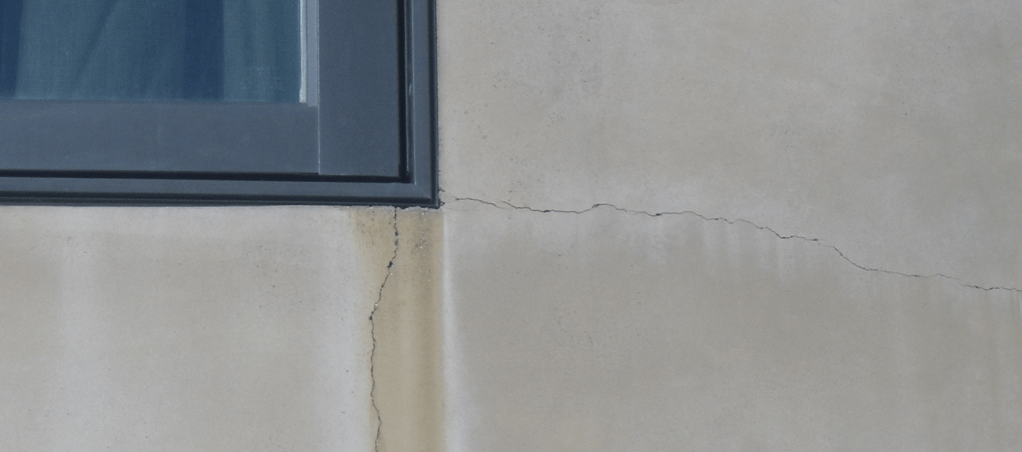
Re-entrant cracking due to a lack of a flexible connection between this window and the
surrounding stucco allows water entry behind the stucco and is unsightly.
Updated 9/13/24 MFC
 RodlerBead